

Perspective B | When the Room Speaks, The American Counterweight: Stewardship, Scale, and the Strategic Use of Corporate Power
- Sylvian Hyde

- May 14
- 5 min read
One of the more interesting aspects of the Beijing summit may not have been what China projected, but how the United States quietly chose to respond. Much of the analysis surrounding President Trump’s 2026 state visit to China has focused on optics that appeared to favor Beijing’s civilizational scale, architectural symbolism, and carefully orchestrated display of continuity. And to be fair, China absolutely understood the stage it was standing on. But sophisticated statecraft is rarely one-sided.
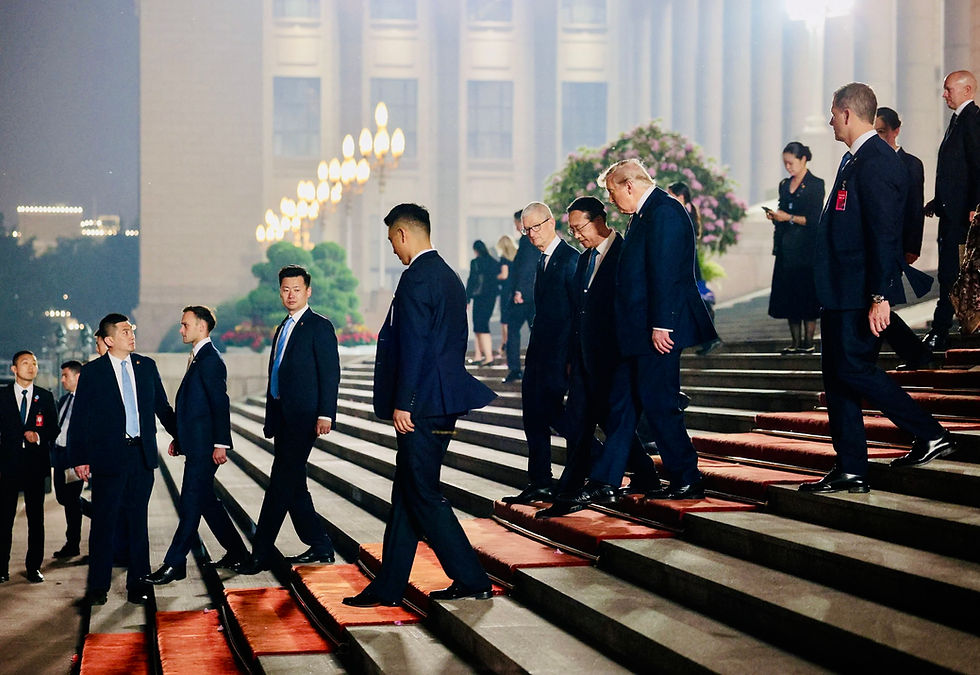
What many observers may have missed was that the American delegation itself communicated a very different form of power, one rooted not in civilizational age or demographic scale, but in the integration of state influence, corporate supremacy, innovation ecosystems, and economic gravity. The inclusion of major American business leaders, including Tim Cook, was not accidental. It was strategic.
In many ways, the delegation itself became America’s counterargument. China’s projection centered around permanence, continuity, institutional patience, and historical scale. America’s projection centered around execution, innovation, commercial dominance, and the extraordinary ability of the United States to organize private-sector power as an extension of national influence. This is one of the defining distinctions between the two systems.

China often projects centralized state civilization. America projects networked economic civilization. Both are forms of power. And in Beijing, the United States appeared fully aware of the room it had entered. The presence of corporate leadership signaled something important: modern geopolitical influence is no longer exercised exclusively through governments, militaries, or treaties. In the twenty-first century, technological ecosystems, supply chains, platforms, intellectual property, semiconductors, operating systems, cloud infrastructure, consumer hardware, AI development, and capital markets have become instruments of national leverage.
In that sense, executives like Tim Cook are no longer merely business leaders. They operate within a sphere where commerce, diplomacy, manufacturing, technology, labor markets, and geopolitical stability increasingly intersect. This may also reveal an under appreciated aspect of Trump’s political instincts.

For all of his confrontational public style, moments like this suggest flashes of practical stewardship and strategic humility. A strong leader does not necessarily attempt to personally embody every form of expertise in the room. A strong leader understands where power actually resides and brings the individuals best suited to engage that terrain. Trump appeared to understand the scale of the stage he was stepping onto. China’s strength is state continuity. America’s strength is its ability to mobilize entire ecosystems of influence.
The image of American corporate leaders descending the monumental staircases of Beijing alongside political officials was symbolically important. It visually communicated that American power does not travel alone. It arrives attached to financial systems, technological infrastructure, consumer ecosystems, research institutions, media dominance, and multinational enterprise. That itself is a kind of empire, not territorial in the classical sense, but infrastructural. And Beijing understands this very well.

This is why the relationship between the United States and China remains so uniquely complex. The two powers are strategic competitors, yet economically intertwined at nearly every layer of the modern global system. Neither side is engaging the other from ignorance. Both understand exactly who they are sitting across from. China presented itself as the ancient civilization ascending confidently into technological modernity. America responded not with historical depth, but with concentrated modern influence: capital, technology, corporations, networks, brands, and market power embodied by some of the most globally consequential companies on Earth.
In other words, while China reminded the room that it has endured for thousands of years, America quietly reminded the room that much of the modern world still runs through American systems. That tension, civilization versus network, permanence versus dynamism, centralized continuity versus distributed innovation, may ultimately become one of the defining geopolitical dynamics of this century. And perhaps the most fascinating aspect of the summit is that both sides appeared fully aware of the symbolism they were projecting. Nothing about this visit felt accidental.

Perhaps the most overlooked aspect of the Beijing summit was that the United States did not arrive empty-handed in a civilizational theater designed entirely by China. America entered the room carrying a different architecture of power altogether. Alongside the political delegation stood what could only be described as a modern American mercantile court, an economic armada composed of captains of industry, technological architects, financial influence, and globally embedded corporate systems that continue to shape much of the modern world. Figures like Tim Cook were not merely executives accompanying a president on a diplomatic trip; they represented an industrial vanguard tied to supply chains, consumer ecosystems, operating systems, semiconductor dependencies, digital infrastructure, and market networks extending across continents.

In many ways, the summit revealed two competing yet deeply intertwined models of power standing face to face. China projected continuity, history, demographic scale, and centralized civilizational confidence. The United States responded with dynamism, innovation, commercial reach, and an Atlantic mercantile bloc whose influence remains woven into the infrastructure of global finance, technology, and consumption itself. Beijing reminded the room that civilizations endure. Washington quietly reminded the room that much of modernity still runs through American systems.
That may be the deeper truth of the summit: neither side entered the room naive about the other. Both understood the scale of the stage, the symbolism of the moment, and the language being spoken without words.

Comments