


The Hidden Founder: Rediscovering George Hyde, Belize’s Unseen Architect
- Sylvian Hyde

- Aug 9, 2025
- 4 min read
Beyond Independence Narratives

Belizean schooling rightly honors George Cadle Price, the independence leader, inaugural Prime Minister, and widely revered “Father of the Nation.” But such a focus risks eclipsing deeper historical roots. Centuries before Price, in the heart of colonial society, there lived a man whose economic power and racial defiance quietly shaped early Belize. His name was George Hyde.
Recently, Belize updated its currency note to feature George Cadle Price. While this is a worthy tribute to his role in the nation’s independence, we must also remember that a country’s currency represents more than its political leadership. The power and stability of the Belize dollar today rests not only on independence-era achievements but also on the economic foundations laid long before. The wealth, trade networks, and business acumen of early figures like George Hyde helped establish the financial strength that Belize inherited at independence. His legacy is woven into the very economic identity of the nation, even if it remains absent from the imagery on its currency.
1. George Hyde: Wealth, Lineage, and Agency
George Hyde was a free-colored man, born around 1795. He was the illegitimate son of affluent Scots-born cutter James Hyde and Adney (or Ariadne) Broaster, herself of African descent. He grew into one of Belize’s wealthiest early merchants, co-owning more than 120 enslaved individuals alongside his father and later managing his own operations through “George Hyde & Co.” by the 1820s (Academia.edu – Elite Reproduction and Ethnic Identity in Belize).
Belize law mandated free-colored individuals to own a minimum of four male slaves before operating logwood or mahogany sites. George’s ownership of 10 in 1816, and five by 1823 alongside significant shared holdings, underscores how he navigated and exploited colonial systems to thrive economically (Academia.edu – Elite Reproduction and Ethnic Identity in Belize).
2. Petitioning for Equity: A Radical Appeal
In 1827, George Hyde traveled to London to deliver a memorial to the Earl of Bathurst. He protested the injustice that, despite his affluence and achievements, he remained barred from civic and military roles, including magistrate and militia commission, purely due to his maternal race (Academia.edu – Elite Reproduction and Ethnic Identity in Belize).
This petition was not empty rhetoric. It revealed enduring systemic racism and Hyde’s courage in confronting it head-on, not through armed revolt but through the corridors of imperial legal authority.
3. Systemic Omission: Why Hyde Remains Invisible
Educational Narratives Favor Independence
Belize’s history education emphasizes political leadership and the decolonization struggle. George Cadle Price fits that mold cleanly. George Hyde’s narrative, which was embedded in economic autonomy and racial contention, does not align easily with this nationalist story, causing his omission.
Structural, Not Malicious, Erasure
This oversight reflects a broader systemic bias. Colonial and post-colonial curricula often sideline the agency of free-colored individuals, especially those operating outside formal politics.
Complex Identity Politics
Colonial hierarchies promoted whiteness and stigmatized mixed-race advantages. Hyde’s position complicates binary views of hero and oppressor, revealing a more layered colonial society.
4. When Identity Became History: Memory and Legacy
The absence of Hyde’s story in mainstream accounts says more about how history values political leadership over socio-economic assertion. His removal from narrative memory underscores how collective identity is constructed and how marginal voices are marginalized again.
Moreover, as we admire the strength of the Belize dollar today, we should acknowledge that its credibility rests on historical layers of economic activity. Hyde’s trade connections, capital accumulation, and early commercial influence helped shape the economic bedrock that later generations, including independence leaders, would build upon.
5. The Invisible Portrait
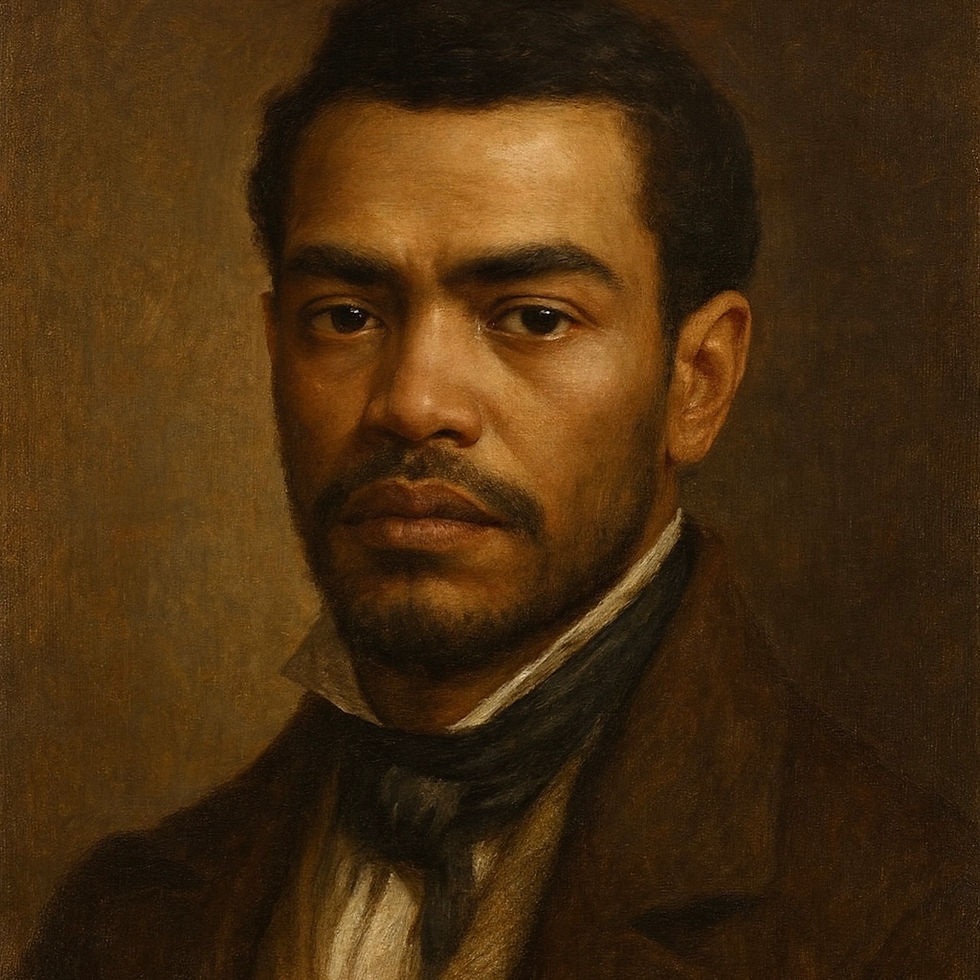
No verified public image of George Hyde appears in textbooks, archives, or online collections. His face, like much of his story, has been erased from the visible record of Belize’s past.
A “Portrait of George Hyde” is listed in the Bancroft Library catalog at the University of California, Berkeley, but it is unclear whether this image depicts the same George Hyde connected to Belize. The library’s catalog provides no details linking it to British Honduras, to his parentage, or to his known life events.
This uncertainty speaks volumes. It reflects not only the scarcity of visual records for free-colored figures in colonial Belize but also how easily their identities can be lost in the archives. Until new evidence emerges, the true likeness of George Hyde remains a mystery — an absence that mirrors his omission from the nation’s collective memory.
Proposed Next Steps: Research, Remembrance, Reform
Educational Reform
Incorporate modules focusing on free-colored agency, economic networks, and early racial law challenges. Textbooks and curricula should present Hyde alongside colonial leaders, not instead of them.
Archival Recovery
Track down the Bancroft Library’s “Portrait of George Hyde.” Investigate census records, merchant logs, and the 1827 memorial, which may be housed in British or Belizean archives, for documentation to authenticate and humanize his story.
Cultural Commemoration
Commission portraits, public art, or articles that elevate Hyde’s legacy, embedding his memory in national consciousness. Academic journals, heritage sites, and community platforms offer appropriate amplifiers.
Reframing Belizean Nationhood
George Hyde may not have crafted the legal construct of modern Belize, but he certainly shaped its early contours through wealth, legal challenge, and social resilience. Recognizing his legacy compels a broader understanding of nationhood, one that includes both political leaders and pioneers who pushed inequitable boundaries with quiet resolve. The next time we look at our currency, we should remember that it carries the weight of centuries , including the foundational work of people like George Hyde.
References

Comments