


The Psychology of Money, INVESTMENTPHOBIA, & Trojan Wealth
- Prayer Hyde

- 3 days ago
- 9 min read
Picture this. You’ve just arrived home from your second job. The clock reads 6:30 p.m. Sitting on the kitchen table is a pile of unopened envelopes. Utility bills. Loan payment reminders. Mortgage notices. Perhaps even a foreclosure warning.
Now imagine witnessing that scene not as an exhausted parent, but as a child. Imagine watching strangers in suits arrive at your home because your family could no longer make the next payment. Imagine hearing conversations about money that were always accompanied by stress, uncertainty, or sacrifice. Before you ever earned your first dollar, your understanding of money had already begun to take shape. Now picture a different childhood. You become a teenager surrounded by social media, celebrity culture, and constant displays of wealth. Birkin bags. Kelly bags. Cartier bracelets on sixteen-year-olds. Mansions. Exotic cars. Influencers whose lifestyles appear effortless.
You are told that diamonds are a girl’s best friend. You are told that men should provide. Yet few people explain how genuine wealth is actually built. Few teach how to invest responsibly, create businesses, accumulate productive assets, or establish financial security without resorting to exploitation or illegal activity. This disconnect affects millions of young people entering adulthood today. Financial literacy is not simply about learning how interest rates work or balancing a budget. It is also about understanding the beliefs we develop about money long before we ever begin managing it ourselves.
The Psychology of Money
Consider two children. The first grows up watching foreclosure notices arrive in the mail. Loans are spoken about with fear. Debt represents failure, and borrowing money is viewed as something to avoid at all costs. By adulthood, that child may see financial institutions as a last resort, even when responsible borrowing could help build a business, purchase a home, or invest in an education.
The second child grows up watching parents use credit responsibly, make investments, and repay loans over time. To that child, borrowing is not a symbol of failure. It is simply one financial tool among many, capable of creating opportunities when used wisely. The difference between these two people is not intelligence. It is not ambition. In many cases, it is psychology. Our earliest experiences shape our relationship with money. Financial instability influences not only how we spend, but also how we perceive risk, opportunity, and our own potential to build wealth.
It is easy to explain financial outcomes by saying, “The system failed me,” “I wasn’t born with opportunities,” or “I didn’t have the right education.” There is truth in acknowledging that opportunity is not distributed equally. However, those explanations alone cannot become permanent identities. If they do, they risk becoming barriers that limit future decisions as much as past circumstances did.
The people we admire also influence our financial psychology. Social media celebrates overnight success, luxury lifestyles, and viral entrepreneurs. We often assume they appeared fully formed, forgetting that many successful people began with uncertainty, setbacks, ordinary jobs, and years of invisible work before anyone knew their names.
Steve Jobs is one example. He left college not because he rejected learning, but because he questioned whether continuing to spend his working-class parents’ savings aligned with his goals. His path was unconventional, but it reflected intentional decision-making rather than blind risk-taking.
Every generation inherits tools the previous generation could only imagine. Information that once required months of research is now available within seconds. Financial statements, business books, investment education, university lectures, and historical case studies are accessible from the device most people already carry in their pocket.
Access to information has never been greater. The challenge is no longer finding knowledge. It is choosing to use it.
Investmentphobia
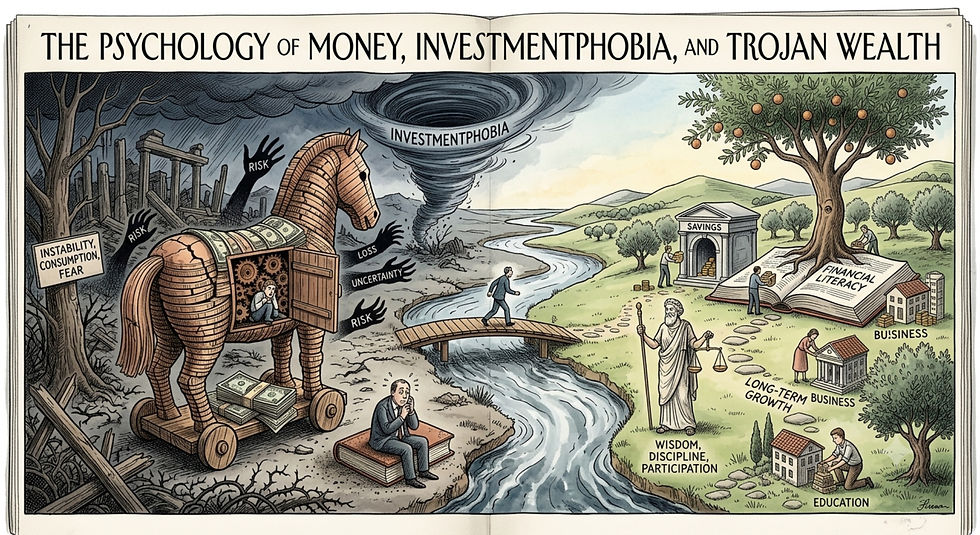
If fear can influence how we spend money, it can also influence how we avoid opportunities. I call this Investmentphobia. Investmentphobia is the fear of allocating financial, intellectual, or physical resources toward improving one’s future because of the possibility of failure, waste, or loss. It is not always obvious. In fact, it rarely looks like fear. Sometimes it appears as procrastination. Sometimes it appears as excessive caution. Sometimes it appears as convincing yourself that “next year” will be a better time to start.
For others, it means avoiding investments altogether. A business idea remains unwritten. A course is never taken. A loan that could responsibly finance an appreciating asset is rejected simply because borrowing itself feels dangerous.
Examples
Peter is predisposed to investmentphobia because he grew up in extreme poverty and associates financial risk with instability.
Mary is gradually overcoming her investmentphobia by learning how markets, banking, and the broader economy work.
Investmentphobia often develops quietly. People may believe they are simply being careful, when in reality fear has become their primary financial adviser.
Healthy caution is essential. Every investment carries risk, and thoughtful decisions require research, patience, and discipline. However, when fear consistently prevents us from investing in ourselves, our education, or productive assets, it can become one of the greatest obstacles to long-term prosperity.
Investmentphobia extends beyond money. It also affects how we invest our time, our attention, and our willingness to learn. Someone who refuses to read because they believe learning will not change their circumstances is experiencing another form of investmentphobia. Likewise, someone who avoids developing new skills because failure feels uncomfortable may unknowingly be limiting their own future. Wealth is rarely created by avoiding every risk.
More often, it is built by learning to distinguish between unnecessary risk and calculated opportunity. That distinction can change the trajectory of an entire life.
Wealth Requires Participation
Investmentphobia is not only about fear. It is also about understanding what money is meant to do. Many people are taught that financial success begins and ends with putting money into a checking or savings account. While both accounts serve important purposes, they are only part of a much larger financial system. A checking account is designed for everyday transactions. A traditional savings account provides a secure place to store money while maintaining liquidity. Neither, on its own, is designed to maximize long-term wealth.
This is where financial literacy becomes important. Money should not simply exist. Whenever appropriate, it should have a purpose. Sometimes that purpose is security through an emergency fund. Sometimes it is earning interest in a high-yield savings account. Sometimes it is investing in education, a business, productive assets, or diversified investments that have the potential to grow over time.
The objective is not to chase every opportunity. The objective is to understand the options available and choose those that align with your goals and your tolerance for risk.
Consider a simple example. A person who deposits $40,000 into an account earning 6% annual interest, assuming the interest compounds annually and the funds remain untouched, would see that balance grow over time. After one year, the balance would be approximately $42,400.
After two years, approximately $44,944.
After three years, approximately $47,641.
Over ten years, the account would continue compounding, demonstrating one of the most powerful principles in finance: money can generate additional money when given sufficient time. The lesson is not that everyone should pursue the same investment strategy. Rather, it is that understanding how financial tools work allows people to make informed decisions instead of fearful ones.
Knowledge transforms money from something we merely spend into something we intentionally deploy. Financial institutions offer a wide range of products, each designed for different objectives. Comparing interest rates, fees, investment options, and lending terms is not unusual. It is one of the habits of financially disciplined people.
Financial aid, credit, and investment are not inherently dangerous. Used irresponsibly, they can become burdens. Used wisely, they can become powerful tools for building long-term opportunity. Perhaps the greatest investment, however, is one that cannot be measured by a bank statement. It is the investment we make in our own knowledge.

Without financial literacy, even substantial wealth can disappear. History is filled with professional athletes, entertainers, entrepreneurs, and lottery winners who accumulated extraordinary fortunes only to lose them through poor financial decisions. Money alone rarely creates lasting wealth. Understanding does.
Trojan Wealth
If Investmentphobia explains why some people struggle to invest in their future, Trojan Wealth helps explain why others mistake consumption for prosperity. I define Trojan Wealth as the pursuit of possessions that create the appearance of financial success while quietly preventing the accumulation of lasting wealth. Like the Trojan Horse, it arrives disguised as something desirable. From the outside, it resembles achievement, influence, or status. Yet beneath that appearance, it can divert money, time, and attention away from assets that appreciate, businesses that generate income, or education that expands opportunity.
Not every luxury purchase is an example of Trojan Wealth. The distinction lies in why we buy. Are we purchasing something because it genuinely enriches our lives, supports our work, or reflects our personal appreciation for craftsmanship? Or are we purchasing it primarily to gain approval, imitate others, or project an image we have not yet built? Those questions matter. Modern consumer culture encourages us to associate visible consumption with success. Social media, reality television, influencer marketing, and advertising often present luxury as the destination rather than the by-product of long-term achievement.
The result is that many people begin pursuing the symbols of wealth before establishing the foundations that create it. This is the essence of Trojan Wealth. It is the illusion of affluence without the infrastructure to sustain it. One of the greatest misconceptions about wealth is that it is always visible. In reality, many of the world’s wealthiest individuals live remarkably private lives. They are often unknown outside of their industries. Their wealth is reflected less in public display and more in ownership, productive assets, businesses, investments, and the freedom to make decisions without financial pressure.
That does not mean wealthy people never purchase luxury goods. Quite the opposite. The difference is often that their purchases follow wealth rather than attempt to substitute for it. Luxury itself is not the problem. A beautifully made garment, a handcrafted watch, or a finely constructed leather bag can represent extraordinary craftsmanship and artistry. Appreciating those things is entirely compatible with financial responsibility. The danger arises when luxury becomes a substitute for financial security rather than an expression of it.
This distinction is particularly important for younger generations. Many brands market products that allow consumers to participate in the image of luxury at relatively accessible price points. There is nothing inherently wrong with this. However, consumers should recognize the difference between buying a product because they value its quality and buying it because they hope it will communicate a level of success that has not yet been achieved.
True wealth rarely needs constant validation. It speaks most clearly through stability, opportunity, ownership, and the ability to invest in the future. Trojan Wealth asks us to reconsider not what we buy, but why we buy it. Abandoning Trojan Wealth and Overcoming Investmentphobia.
If Investmentphobia is rooted in fear, and Trojan Wealth is rooted in illusion, then overcoming both begins with changing our understanding of wealth itself. The first step is recognizing that wealth and consumption are not synonymous. Expensive clothing, luxury cars, and designer accessories can certainly be enjoyed, but they should not become substitutes for financial security, education, ownership, or long-term planning. Wealth is not measured solely by what people can see. More often, it is reflected in what cannot be seen: knowledge, discipline, opportunity, productive assets, and financial resilience.
Education remains one of the most accessible forms of investment available. There are two forms of education that deserve equal attention. The first is formal education, obtained through schools, colleges, universities, and professional training. The second is self-education. Self-education requires curiosity, discipline, and consistency. It means reading books beyond the classroom, studying industries that interest you, learning how businesses operate, understanding financial markets, and asking better questions. It often takes years, but its value compounds just as investments do.
A library card, a thoughtfully chosen book, a credible online lecture, or a conversation with someone who has already solved a problem you hope to solve can all become investments in your future. Knowledge, however, is only the beginning. Information that is never applied remains little more than entertainment. Financial literacy becomes meaningful when it influences the decisions we make: how we save, what we invest in, which risks we accept, and what kind of future we choose to build.
There will always be reasons to postpone learning. There will always be reasons to delay investing in yourself. There will always be reasons to believe that someone else had advantages you did not. Those realities may be true. They should not become permanent limitations. Every generation inherits challenges. Every generation also inherits opportunities. Perhaps the greatest opportunity of this generation is access to information. Never before have so many books, lectures, financial reports, business case studies, and educational resources been available to so many people at so little cost.
The question is no longer whether knowledge exists.
The question is whether we are willing to pursue it. Financial freedom is rarely built through one extraordinary decision. It is built through hundreds of ordinary decisions repeated consistently over time. Every book read. Every skill developed. Every thoughtful investment. Every disciplined financial choice. Those are the quiet habits that eventually become wealth.
Final Thoughts
Money is not simply a financial resource. It is also psychological. The stories we inherit, the environments we grow up in, and the beliefs we develop all influence how we approach opportunity, risk, and success. Understanding that psychology is not about assigning blame. It is about recognizing that our financial habits can be examined, challenged, and changed. If Investmentphobia teaches us to recognize fear, and Trojan Wealth teaches us to recognize illusion, then perhaps genuine wealth begins with something much simpler:
Learning to think differently. Because before we change our finances, we often have to change our minds.


Comments